
Print specification
UV printing on PP hollow board.
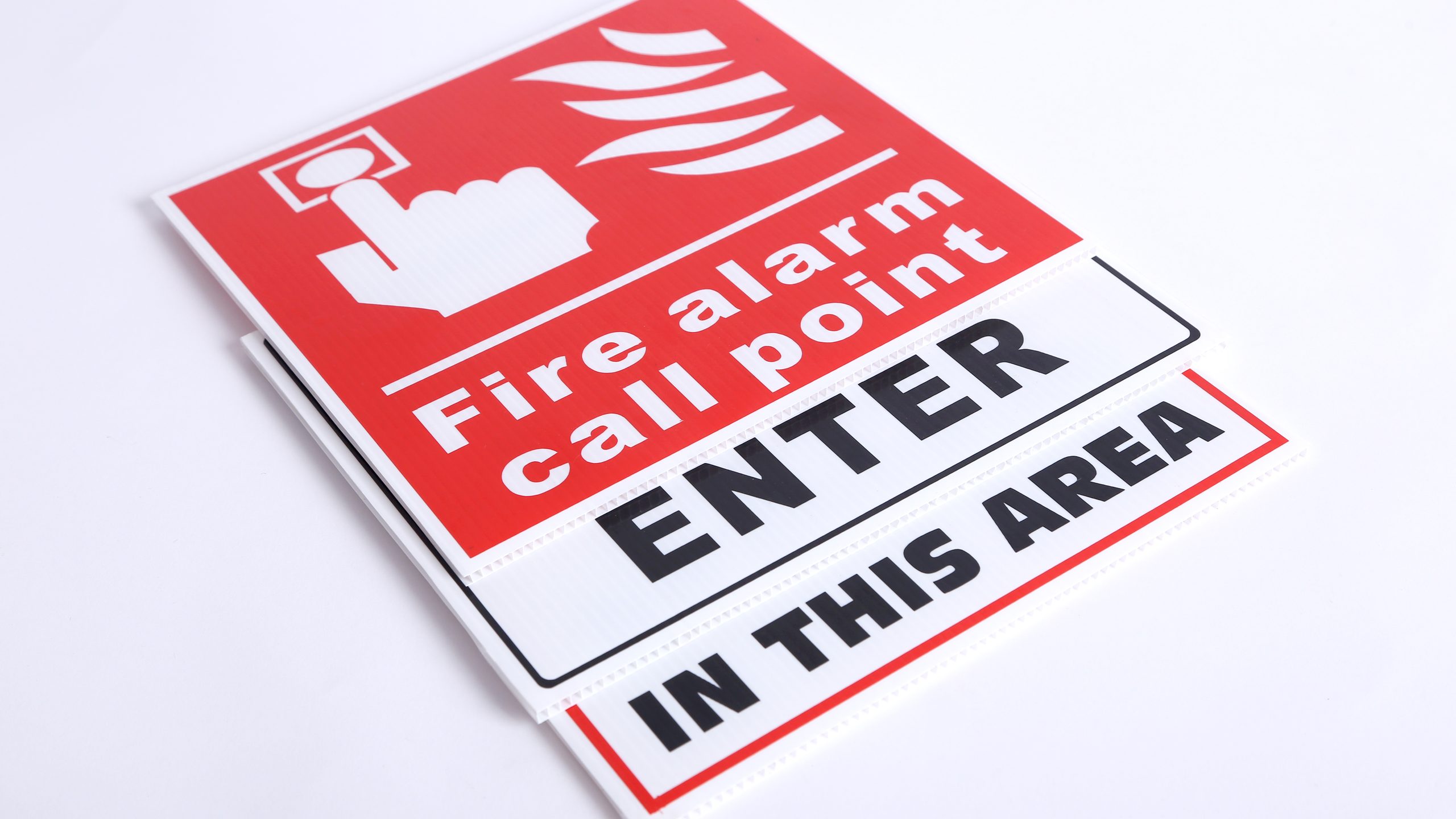
Full-colour UV inkjet printing on the outer face of twin-wall PP sheet and finished boxes. This page covers the print capability, the surface preparation behind it, and the prepress rules we ask artwork to follow.
At a glance
Print specification at a glance.
- Print method
- UV inkjet, full colour
- Print face
- Outer face only
- Resolution
- Up to 1200 × 1200 dpi
- Max print width
- 2,600 mm, full panel
- Surface treatment
- Corona, ≥ 46 dyne/cm
- Test method
- ASTM D2578
Surface
Surface preparation
The face that will be printed is corona-treated to a minimum of 46 dyne/cm, checked on the extrusion line to ASTM D2578. Corona raises the surface energy so the UV ink wets and keys to the polypropylene. Treatment of both faces is available on request.
The corona value is a surface-energy measurement taken on the board. It is a preparation check, not a print-adhesion result, and it does not by itself guarantee adhesion on a finished box.
Ink & durability
Ink, adhesion and durability
| Property | How it is handled |
|---|---|
| Ink | UV-curable ink, applied to the outer face only. |
| Adhesion | Confirmed against the ink supplier’s data sheet for the ink actually used. Cross-hatch adhesion testing is arranged to order; method and acceptance criteria on request. |
| Rub and abrasion | Confirmed against the ink supplier’s data sheet for the ink actually used. A test method is provided on request. |
| Wet rub and moisture | Depends on the ink, the board and the actual use. We confirm the method and the condition per order; ask us for the data for your configuration. |
| Water-spray performance | Arranged to order. It depends on the box, the board grade and the way the box is used. |
We do not publish a generic adhesion, rub or humidity figure. Where a buyer needs a report, testing is arranged for the ink and board actually ordered.
Colour
Pantone matching and colour tolerance
Colour is matched to the approved physical print sample, not to a screen. Named Pantone references can be run; where the artwork carries a Pantone, keep it as a named or spot colour in the file rather than an RGB value.
Any colour-difference tolerance is confirmed per order for the artwork and board grade concerned. We do not publish a general colour-difference figure, because the achievable difference depends on the substrate, the image and the ink coverage.
Artwork
Artwork and files
- Supply artwork at final size, 1:1, as a vector PDF or the native file. Outline the fonts, or send the font files with the artwork.
- Colour: CMYK for process images; keep Pantone references as named or spot colours.
- Images: embed raster images at the effective resolution needed for the final size; the press prints up to 1200 × 1200 dpi.
- Boxes: send the panel drawing or dieline with the artwork, and state the flute direction and the print face.
- Keep text and logos clear of folds, slots and handle openings, and send a layered source file as well as a flattened proof.
- Screen colour is not a reference. The approved sample is.
Bleed
Bleed and safe area
Artwork is prepared at final trim size, with the printed image extending past the finished cut on every side. The exact bleed and safe margin are shown on the panel drawing we send for approval; if your file already carries a bleed, tell us the value you used so we do not add it twice.
Prepress
What we check before printing
Artwork. File format and size, outlined fonts, embedded images, Pantone references, bleed and safe area, and the panel drawing.
Material and layout. Board grade and thickness, flute direction, print face, panel layout and folds, and the approved physical print sample.
Board range and tolerances: see specifications. Board properties: see the technical data sheet. Load, stacking and water-spray performance are handled on performance and verification. For the fire wording, see fire performance.